








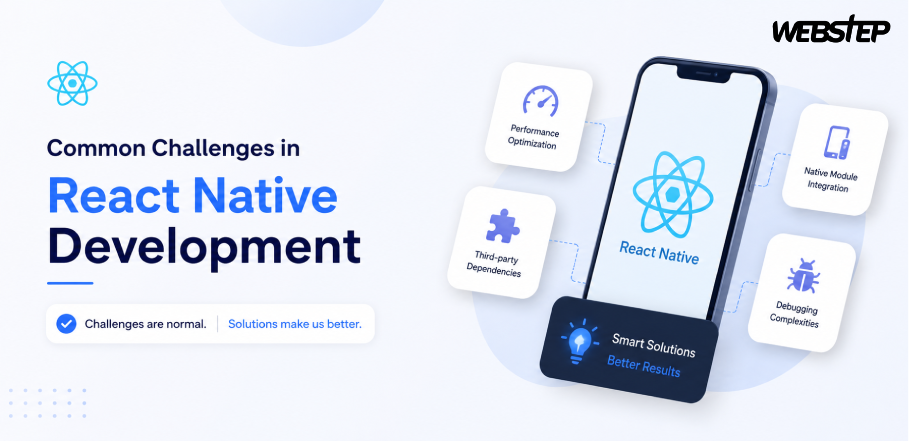
Mobile applications have become an essential part of modern business growth. Companies are increasingly investing in React Native App Development to create high-quality applications that work seamlessly across both Android and iOS platforms. As a leading framework for Cross-Platform Mobile App Development, React Native helps businesses reduce development time, lower costs, and reach a wider audience with a single codebase.
Developed by Meta, React Native allows developers to create applications for both Android and iOS using a single codebase. This approach helps reduce development time, lower costs, and simplify maintenance. However, like any technology, React Native comes with its own set of challenges.
Understanding these challenges and learning how to solve them can help businesses and developers build faster, more reliable, and high-performing mobile applications. In this article, we will explore the most common challenges in React Native development and practical solutions to overcome them.
Understanding React Native Development
React Native is an open-source framework that enables developers to build mobile applications using JavaScript and React. Instead of creating separate applications for Android and iOS, developers can write a significant portion of the code once and deploy it across multiple platforms.
This approach provides many advantages, including:
- Faster development cycles
- Reduced development costs
- Easier maintenance
- Code reusability
- Strong community support
Despite these benefits, developers often face technical challenges that can affect app performance, stability, and user experience.
Performance Issues
Performance is one of the most discussed challenges in React Native development. While React Native delivers excellent performance for most applications, complex apps may experience slow rendering, lagging animations, or delayed responses.
Common Causes
- Large application size
- Excessive API calls
- Poor state management
- Unoptimized images
- Heavy third-party libraries
How to Solve It
Developers can improve performance by:
- Using optimized images and media files
- Minimizing unnecessary re-renders
- Implementing efficient state management
- Using FlatList for large data sets
- Reducing dependency on heavy libraries
Regular performance testing helps identify bottlenecks before they impact users.
Platform-Specific Differences
Although React Native supports cross-platform development, Android and iOS do not always behave the same way.
Common Issues
- Different UI designs
- Device-specific functionality
- Navigation inconsistencies
- Platform-specific permissions
How to Solve It
React Native provides tools such as Platform APIs that allow developers to create platform-specific code when necessary.
Best practices include:
- Testing on both Android and iOS regularly
- Following platform-specific design guidelines
- Creating separate UI components when needed
- Using responsive layouts
Proper planning helps ensure a consistent user experience across devices.
Managing Third-Party Dependencies
Most React Native projects rely on third-party libraries to add functionality quickly. However, dependency management can become challenging as projects grow.
Common Issues
- Library compatibility issues
- Outdated packages
- Security vulnerabilities
- Frequent updates
How to Solve It
Developers should:
- Choose well-maintained libraries
- Regularly update dependencies
- Monitor package security reports
- Remove unused packages
Keeping dependencies organized reduces the risk of project instability.
Navigation Complexity
Navigation plays a critical role in mobile applications. As applications become larger, navigation structures become more complex.
Common Issues
- Deep navigation hierarchies
- Screen transition issues
- State persistence problems
- Performance slowdowns
How to Solve It
Developers can use trusted navigation libraries and maintain a clear navigation structure.
Recommended practices include:
- Organizing screens logically
- Avoiding unnecessary nested navigators
- Testing navigation flows thoroughly
- Optimizing screen loading
Simple navigation improves both performance and user satisfaction.
Native Module Integration
Some advanced mobile features require access to native Android or iOS functionality.
Examples include:
- Bluetooth connectivity
- Camera integrations
- GPS services
- Biometric authentication
Common Issues
- Native code complexity
- Compatibility challenges
- Increased development time
How to Solve It
Developers should:
- Use reliable native modules
- Follow official documentation
- Test integrations extensively
- Maintain platform-specific expertise
Proper implementation ensures stable functionality across devices.
Debugging Complex Applications
Debugging can become difficult when working with large React Native applications.
Common Issues
- Multiple device environments
- Native code integration
- Network-related issues
- State management errors
How to Solve It
Modern debugging tools make troubleshooting easier.
Useful approaches include:
- Using React Native Debugger
- Monitoring application logs
- Testing API responses carefully
- Implementing error tracking systems
A structured debugging process helps identify and resolve issues faster.
Application Security
Security is a major concern for every mobile application.
Common Risks
- Data leaks
- Insecure API communication
- Weak authentication systems
- Sensitive information exposure
How to Solve It
Security should be integrated throughout the development process.
Best practices include:
- Using HTTPS for all communications
- Implementing secure authentication
- Encrypting sensitive data
- Performing security audits regularly
A strong security strategy protects both users and businesses.
State Management Difficulties
As applications grow, managing data becomes increasingly complex.
Common Problems
- Data leaks
- Data inconsistency
- Excessive component updates
- Difficult debugging
How to Solve It
Developers can use modern state management solutions such as Context API, Redux, or Zustand.
Additional recommendations include:
- Keeping state structures simple
- Avoiding unnecessary global state
- Separating business logic from UI components
Efficient state management improves application stability and scalability.
Handling App Updates
Mobile applications require continuous updates to stay competitive and secure.
Common Challenges
- Version compatibility
- Deployment delays
- User adoption issues
How to Solve It
Teams should establish a clear update strategy.
This includes:
- Regular testing before release
- Monitoring user feedback
- Maintaining backward compatibility
- Automating deployment processes
A structured update process helps deliver improvements without disrupting users.
Device Fragmentation
The mobile market includes thousands of devices with different screen sizes, operating systems, and hardware capabilities.
Common Challenges
- UI inconsistencies
- Performance variations
- Hardware compatibility issues
How to Solve It
Developers should:
- Use responsive design techniques
- Test on multiple devices
- Optimize resource usage
- Support a wide range of screen resolutions
Comprehensive testing helps ensure a consistent experience for all users.
The Future of React Native Development
React Native continues to evolve rapidly. New architecture improvements, enhanced performance capabilities, and stronger community support are making the framework even more powerful.
Businesses increasingly choose React Native because it allows them to build high-quality applications faster while maintaining a consistent experience across platforms. As mobile technology advances, React Native is expected to remain a leading framework for cross-platform app development.
Conclusion
React Native offers significant advantages for businesses looking to build mobile applications efficiently. However, developers must address challenges such as performance optimization, platform-specific differences, dependency management, navigation complexity, security concerns, and device fragmentation.
By understanding these common challenges in React Native development and applying the right solutions, businesses can create reliable, scalable, and user-friendly mobile applications. A proactive development strategy, continuous testing, and adherence to best practices will help ensure long-term success and deliver an exceptional experience for users across Android and iOS platforms.